The short answer
A fully music-covered wedding day — ceremony, drinks reception, dinner and party — costs €5,000–€9,000 excl. 6% VAT in Belgium; a single well-chosen moment is possible from €900. The key to a successful day isn't more music, but one coherent musical thread: each phase with its own mood, with smooth transitions between them.
Ready to book? Request a no-obligation quote — response within 24 hours.
Request a quote → Or start the Matchmaker →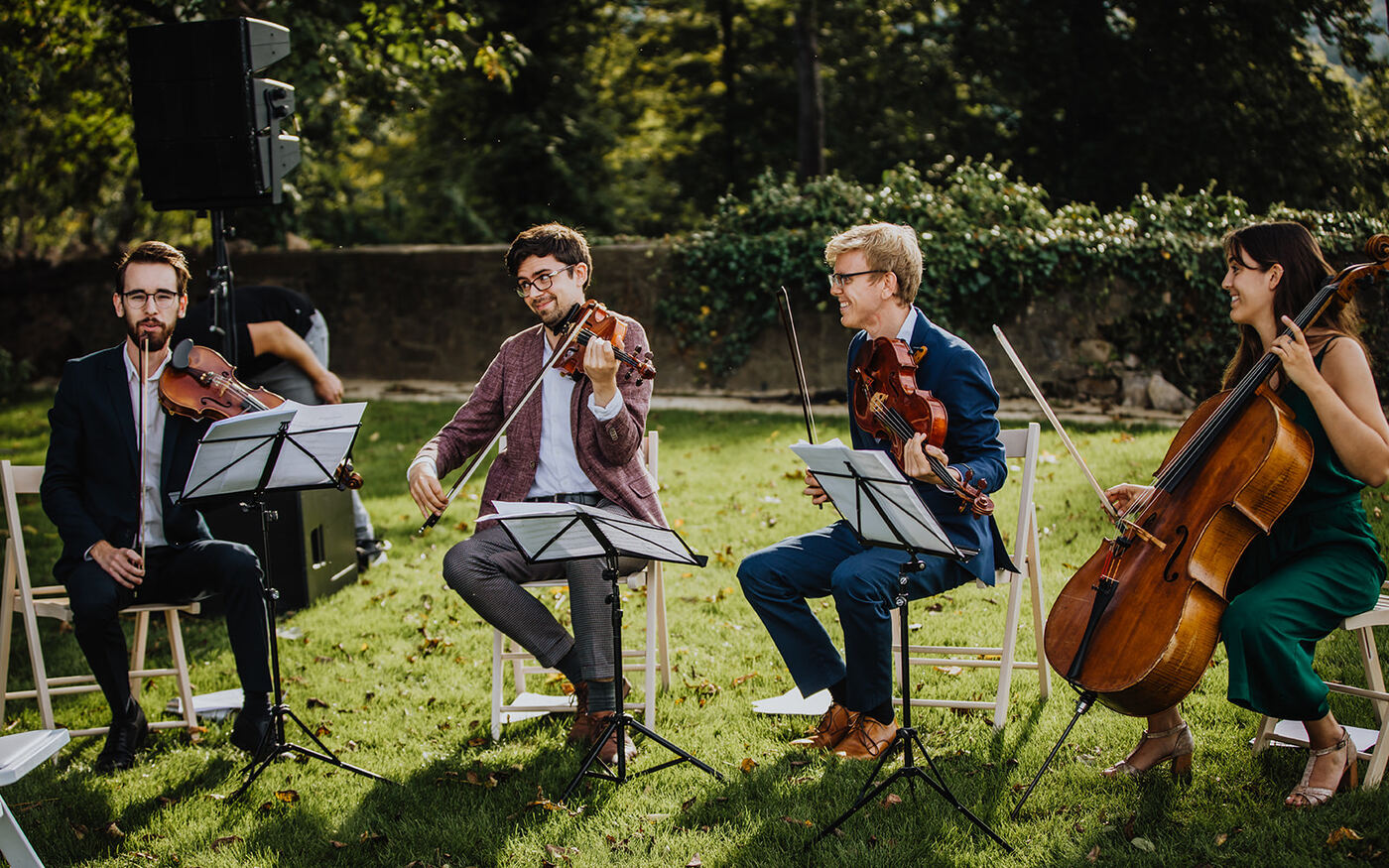
Think in moments, not in bands
Most couples begin their search with an ensemble: "we want a string quartet" or "we're looking for a cover band." Understandable, but it's the reverse order. A wedding day is an arc of emotions — solemn, relaxed, warm, exuberant — and the music should follow that arc. So start with the moments of your day, decide the mood you want for each, and only then choose the ensembles that bring it to life. This guide follows that order, with a reference to our in-depth guides for each sub-topic.
The four moments of a wedding day
1. The ceremony: the emotional heart
Musically, a ceremony consists of three clearly defined moments. The processional announces your arrival — the music should fill the room without overshadowing your own emotion. During the vows and ring exchange, silence is often the most powerful instrument; those who still want music choose something intimate that stays in the background. The recessional can reflect the joy: upbeat and festive, without becoming exuberant. The most commonly chosen ensemble for this is a string quartet — fully acoustic, so with no technical risk whatsoever, and at home in any space from church to castle. A ceremony package with a quartet starts from €1,650 excl. VAT. All the detailed choices, including for jazz duos and bespoke ensembles, are covered in music for the wedding ceremony.
The form of your ceremony shapes the musical treatment. In a church, the acoustics are a gift for acoustic ensembles and the service usually includes more musical moments — align your choices with the officiant too, since some parishes have guidelines on repertoire. At the registry office, the ceremony is short and the playing space limited: two or three pieces are often enough, and not every venue allows live music — check in advance. With a freestanding ceremony at your venue or outdoors, you decide everything yourself: the most rewarding canvas for live music, with the only points of attention being the room's acoustics and, outdoors, a sheltered set-up.
2. The drinks reception: the tension eases
After the ceremony, the day relaxes. Guests offer congratulations, glasses are filled, conversations start up — and the music shifts from solemn to light. A jazz duo (Along Comes Mary, from €900 excl. VAT) or an acoustic duo with Belgian repertoire (Belpop Acoustic, from €950) carries a roughly 90-minute reception without ever getting in the way of conversation. The transition from string quartet to jazz duo is not by accident our most-booked combination: the contrast between solemn gravity and light elegance surprises guests at exactly the right moment.
3. The dinner: carrying without overpowering
During the meal, volume control is everything: present enough to keep the room warm, discreet enough to spare table conversations. Bossa nova (Swamba, a trio with sound system included, from €1,260) is a natural choice here; a jazz trio (from €1,380) offers the same comfort in a different register. Agree with the ensemble that the volume may rise slightly between courses and drop completely during speeches.
4. The party: filling the dance floor
The big choice of the evening: cover band or DJ? A live band — with us the five-piece Belpopband with light show, from €2,500 excl. VAT — brings something no DJ can reproduce: the physical energy of musicians in the same space as your guests. A DJ (DJ Stecks, €500–€750 in the low season, €1,000–€1,500 in the high season) in turn has literally every song at hand and adapts on the spot. More than half of our couples ultimately choose the combination: the band plays two sets at the peak of the evening, the DJ warms up and closes. Don't forget the first dance in your arrangements either: agree in advance whether the band plays your song live (send it well ahead of time so it can be rehearsed) or the DJ plays the original recording — both work, but it needs to be a choice, not an improvisation. And decide who opens the dance floor afterwards: a band that plays straight on or a DJ who takes over seamlessly keeps the momentum going. The full trade-off — including space, breaks and budget — is covered in cover band or DJ at your wedding.
Which songs work for each moment?
The question every couple asks themselves — and one with no wrong answer, but a good method. Three guidelines from experience:
- Processional: choose between timeless and personal. The classics — Pachelbel's Canon, Bach's Air, Mendelssohn's wedding march — have worked for centuries because they carry anticipation and solemnity within them. Equally valid: a string quartet arrangement of the pop song that tells YOUR story. An arrangement makes a familiar song ceremonial without losing its meaning.
- Vows and rings: less is more. One short, intimate piece — a solo violin, a restrained duo — or deliberately chosen silence. This moment is about the words, not the music.
- Recessional: energy without exuberance. Vivaldi's Spring, a sunny jazz standard or an upbeat pop arrangement sets the tone for the rest of the day.
The best approach: choose the two or three songs that really matter yourself (processional and recessional first) and let the ensemble fill in the rest of the programme — they know what works in which space and at which moment. Professional ensembles are happy to take specific requests; unusual repertoire sometimes needs extra rehearsal time.
A sample day: what a fully music-covered wedding day sounds like
To make it all concrete: the musical timeline of a wedding with 120 guests as we regularly accompany it.
- 1:30pm — The string quartet sets up at the ceremony venue (20–30 minutes, no soundcheck needed) and plays quietly as guests arrive.
- 2:00pm — Ceremony: processional, one intimate piece during the ring exchange, festive recessional. The quartet follows the timing of the ritual, not the other way round.
- 3:30pm — Drinks reception: the jazz duo takes over on the terrace. The mood shifts from solemn to light — guests feel the day opening up.
- 6:00pm — Dinner: bossa nova at a whisper volume; a touch louder between courses, completely silent during speeches.
- 9:30pm — First dance, immediately followed by the band's first set: the dance floor fills while the energy is already there.
- 10:30pm–1:00am — Band and DJ alternate: two live sets at the peak of the evening, the DJ before, between and after. End time as agreed — extensions at the hourly rate in the contract.
Note what characterises this day: no gap without music anywhere, but also nowhere music competing with the programme. Four ensembles, one thread. This exact scenario, with the current total price, can be found as Scenario A on our pricing page.
Which ensemble suits you?
| Profile of your day | Logical choice | Guide price (excl. VAT) |
|---|---|---|
| Classical and solemn | String quartet | From €1,650 |
| Warm and informal | Jazz duo (Along Comes Mary) | From €900 |
| Familiar Belgian | Belpop Acoustic | From €950 |
| Fully bespoke line-up | Vitrine Op Maat | €400 per musician |
| Party with live energy | Belpopband | From €2,500 |
| Party with maximum variety | DJ Stecks (or combined with band) | €500–€1,500 |
Torn between the two main registers for the ceremony? The trade-off is set out in string quartet or jazz band; the honest pros and cons of the quartet in a string quartet at your wedding. And if you're assessing an ensemble found elsewhere, use the five criteria in how to judge the quality of an ensemble.
What does wedding music cost?
Four realistic scenarios based on our own rates:
| Scenario | Line-up | Budget (excl. VAT) |
|---|---|---|
| One moment | Acoustic duo for the reception or ceremony | From €900 |
| Two moments | Ceremony (quartet) + DJ for the party | From €2,400 |
| Three moments | Quartet + jazz duo + DJ | From €3,550 |
| Full day | Four ensembles, four moods | From €6,310 |
A useful rule of thumb: reserve 10–15% of your total wedding budget for music. For comparison with the wider market: in Belgium and the Netherlands you typically pay €600–€1,500 for an acoustic duo, €1,200–€3,000 for a professional string quartet, €2,500–€6,000 for a full cover band and €600–€1,500 for a DJ — for Dutch prices, watch the VAT difference (9% there, 6% here; see Cultuurloket) and separate Buma surcharges. The full price breakdown per item is in how much does music for a wedding cost; the items couples forget most often — travel surcharges, sound equipment, extra hours — in the hidden costs of live music.
When do you book what?
For a Saturday in spring or autumn (April–June, September–October), 6 to 12 months in advance is the norm; the busiest weekends in May and June are often already full by December–January. The proven timeline: around 12 months before the day, a first conversation (date and mood, no detailed programme yet); around 9–10 months, fixing the date with a deposit and contract; around 3–4 months, the detailed programme — repertoire, timing, technique — and 2–3 weeks ahead, final planning with exact times and contact people. The full step-by-step plan, including what to do if you're running late, is in when to book music.
Technique and logistics: invisible when done right
Three things determine the day's comfort. Sound and power: a string quartet and acoustic ensembles need nothing; Swamba and Belpop Acoustic bring their own amplification; for the Belpopband and DJ Stecks, sound equipment is arranged separately — the overview per ensemble is in sound equipment: what's included. Set-up and soundcheck: allow 20–30 minutes for acoustic ensembles up to 60–90 minutes for the band, and always schedule the soundcheck before guests arrive; playing durations per ensemble type are in how long does an ensemble play. Getting married outdoors? Acoustic ensembles are surprisingly often the best choice outdoors, provided there's shade, shelter from wind and a weather plan — the full playbook is in live music outdoors.
Watch out for: the sound limiter
More and more Belgian function venues use a sound limiter that cuts the power the moment volume crosses a set threshold — mid-song, with an awkward silence as a result. So ask your venue explicitly whether a limiter is fitted and at what level it's set, and pass that on to the band or DJ before booking. A professional band can adapt its set to a strict limit, but needs to know in advance; in venues with a very low threshold, a DJ or an acoustic line-up is sometimes simply the better choice. This one phone call prevents the most embarrassing technical surprise of a wedding evening.
Contract and paperwork
One failed performance on a wedding day is irreparable — which is why every booking belongs on paper. A solid contract covers ten things, including fee and VAT (6% in Belgium), playing time and sets, cancellation terms in both directions and a force majeure clause; the full checklist is in what should be in a live music contract. Good news on music rights: at a wedding reception in a function venue, music use is usually covered through the venue's annual licence — exactly how that works, and what you need to arrange yourself for a reception on your own grounds, is covered in Sabam, Unisono and the Fair Remuneration.
Arrange it yourself or get guidance?
Honest answer: it depends on your day. Booking a single ensemble you already know for a simple party — go ahead and do it yourself. Filling a full day with multiple ensembles, and your own time investment quickly climbs to 10 to 20 hours per ensemble — searching, comparing, following up quotes, reading contracts, coordinating technique. The trade-off, including the price question ("is it cheaper direct?" — rarely significantly) is covered in via an agency or directly with the band; what a guided process actually involves in what is a music consultant.
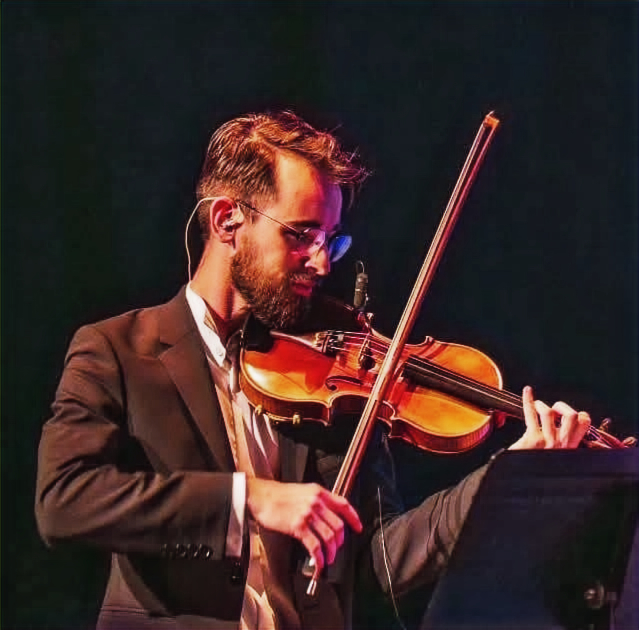
"The nicest compliment I can get after a wedding isn't 'what a great band' — it's 'the whole day just worked.' That's the difference between four separate bookings and one musical thread: guests can't name what was good, but they feel it from the first note to the last dance." Reinout Pauwels — music consultant at De Muziekvitrine
The five most common mistakes
- Budgeting for music last. After the venue, catering and photographer, there's too little left for the element that carries the day's atmosphere. Reserve the 10–15% up front.
- Booking too late for a popular date. A Saturday in June doesn't come round again; anyone still searching three months out picks from what's left.
- Four separate bookings with no common thread. Each ensemble can be excellent individually and the day can still feel disjointed; the transitions between moments deserve as much attention as the moments themselves.
- Forgetting the technical side. No power supply for the band, a soundcheck during the reception, a loading zone that isn't accessible — all avoidable with one coordination call between ensemble and venue beforehand.
- Booking without a solid contract. Especially the cancellation terms for the ensemble — the clause almost nobody asks for, and the one that protects the most.
Your step-by-step plan
1. Determine the moments of your day and the mood for each. 2. Reserve the date with the ensembles as soon as it's fixed — you'll refine the programme later. 3. Put everything in a contract with clear cancellation terms. 4. Align repertoire and technique with the ensemble and venue 3 to 4 months ahead. 5. Confirm the final schedule 2 to 3 weeks ahead and appoint one point of contact for the day itself.
The common thread
A successful musical wedding day isn't a sum of good ensembles, but one continuous thread: solemn where it belongs, light where it can be, exuberant where it's allowed — with transitions nobody notices because they're right. That doesn't require a bigger budget, just a plan. And for those who'd rather build that plan together: the first conversation at De Muziekvitrine is free and without obligation.